
Everyone else is selling AI pilots.We ship production.
Vanguard Signals takes AI out of proof-of-concept and into systems that run, get measured, and keep working after the launch deck is filed.
- UBS
- Deutsche Bank
- Banc of America
- Citi
- Millennium Partners
- SIX Payment Services
- Worldline
01 — Engagements
Five shapes of work
Each scoped to a decision someone has to make, rather than a technology someone wants to buy.
Strategy
Where AI and automation create measurable value — and, just as often, where they do not. Portfolio roadmaps, governance posture, and a business case that survives a second reading.
Architecture
Design and assessment of retrieval systems, agent workflows and model routing, integrated with the data, APIs and services already in place.
Delivery
End-to-end leadership from concept to production. Through your team where possible, with partners where sensible, directly where speed or confidentiality requires it.
Adoption
Knowledge transfer that leaves ownership behind, paired with the executive alignment that keeps adoption from stalling at the pilot.
Governance
Frameworks, policies and portfolio KPIs so initiatives stay auditable and stay pointed at outcomes that can actually be counted.
03 — Work
Shipped and public
AI engineered projects that highlight the use of LLMs and clustering applications within products.
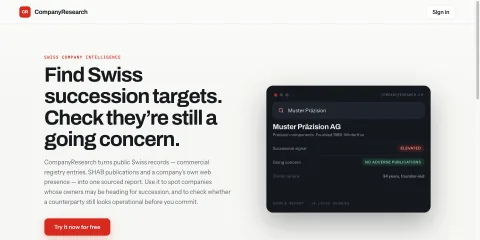
Research any Swiss company
Turns public Swiss registry entries, SHAB publications, and web presence into sourced reports for succession targeting and going-concern checks.
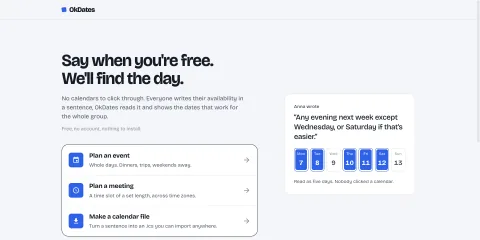
Using LLMs for date and meeting time evaluation
Accepts free-form availability inputs for large groups and suggests meeting slots without manual polling.
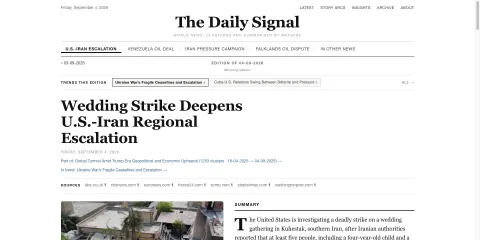
Clustering & summation
Crawls news sources, cleanses copy with GenAI, clusters related stories, and pairs summaries with generated imagery.
04 — Notes
Written while the work was happening
Field notes and thought leadership.
Code is now free, Software is not
I wanted to write this post for several months now, just because of my own experiences and also what I hear more and more from my network. The executive summary sentence goes...
AI Is Beginning to Imitate Art
About 30 years ago, I had the pleasure of reading the science-fiction novel The Two Faces of Tomorrow by James P. Hogan. In the novel, an AI named Spartacus is put in charge of an...
Fable 5 Joins the 3D Maze Runner Race
A Continuation of the Opus 4.8 vs. GPT-5.5 Rematch In the last round I compared Opus 4.8 in Claude Code with GPT-5.5 in Codex on the same 3D maze runner challenge I had used...
05 — About
Who does the work
Vanguard Signals is a senior practice. The person who scopes the engagement is the person who delivers it.
Vanguard Signals was founded in Zürich by Urs Gubser, whose career spans engineering, systems administration, business analysis, product, programme and transformation leadership across global financial institutions and technology providers including UBS, Deutsche Bank, Banc of America, Citi, Millennium Partners, SIX Payment Services and Worldline.
In recent years, the focus has been on designing and implementing AI-based solutions in real-world, regulated environments. This includes hands-on work with Retrieval-Augmented Generation (RAG), agentic toolchains, and AI-enabled workflows, using a broad spectrum of models—open-weight and proprietary, quantized for efficiency, and deployed via on-premise, hybrid, or inference-provider-based architectures. The work goes beyond experimentation, emphasizing production-grade AI systems that integrate with existing data, APIs, and software architectures, align with governance and compliance requirements, and deliver measurable operational and strategic impact. Experience covers the full lifecycle, from architecture and model selection through implementation, adoption, and continuous evolution.
06 — Contact
Whether this is a fit
If the shape of the work matches, write directly.